Prior to this trip, I read a handful of blogs and forums to get an idea of what to expect, more or less. I’ll preface by saying that in all my travels thus far, I’ve never encountered a place with more mixed reviews. So take all that I write with a grain of salt. My experience and your experience can, and will, differ immensely based on a number of factors—race, cultural background, and gender, to name a few.
My posts are usually centered around the highlights of each city I travel to, but in all honesty, the cultural experience definitely outweighed the sightseeing. Thus, this post in particular will focus more on the cultural aspect than the physical destination itself.

Getting Around
There are all sorts of modes of transportation—everything from donkeys and mules to cars, buses, and motorbikes. If you have more than two weeks to explore Morocco, I would recommend taking the bus to avoid the headache and anxiety of driving yourself. If you’re in a time crunch and would like to get more off-the-beaten path, I would definitely recommend renting a car. However, renting a car comes with the additional burden of finding parking and navigating the chaotic traffic. In a nutshell, here’s what I discovered driving around Morocco:
- Expect traffic everywhere (after 9am) – Traffic is horrendous regardless of the size of the city. I believe there are several reasons attributed to this…and one of the most obvious reasons you’ll come to discover is that there are no protected left turn signals or left turn lanes. The result is complete back-up that results in full grid-lock, then drivers circumventing the clog by squeezing past on the shoulder. It’s just complete chaos, but funnily enough, an understood chaos.
- There are a lot of roundabouts, and the rules are weird – This was super confusing because sometimes there were traffic lights into the roundabout and other times there wasn’t. Where there were traffic lights, green light cars have right of way even if there are already other cars in the roundabout. The cars in the roundabout had to stop and wait. Bizarre! But if there were no traffic lights to the roundabout, the cars in the roundabout have right of way.
- Cops and speed traps are everywhere – I mean, EVERYWHERE, even on mountainous roads. Thankfully, people are kind enough to give you a little headlight flash to warn you of cops ahead. Pay close attention to the speed limits and don’t speed. Cops are notorious for pulling over unaware tourists and whoever they can get. For example, the main highway has a posted speed limit of 120 km/hr. After we passed a toll booth on the highway, I naturally assumed it resumed that speed limit. NOPE. It was 80km/hr. Consequently, I got pulled over and had to pay a hefty 400 MAD out-of-pocket. And no, they don’t take credit card. That said, it’s always good to carry at least 1000 MAD on you, and plenty of change.
- Take the toll roads – Just do it. The toll roads are in much better condition than the other highways that are not well-kept. Toll roads also have at least 2 lanes both ways, which makes passing cars easier. Most other roads are usually a one-lane road, and when you’ve got a caravan of cars ahead, overtaking can be challenging and slightly stressful depending on the area. The tolls range anywhere from 13 MAD ($1.50) to 80 MAD ($10). Some toll booths are unmanned and equipped with blue boxes. Because it’s a quick button push and go, there’s rarely ever a line. Press the button on the blue box, grab the ticket, and continue on your way. The next set of toll booths will most likely be orange and manned—you’ll know this when you see a line of cars from far away. Hand the ticket to the toll operator and look on the screen ahead (next to the liftgate) to see the amount you owe.

Ourika
Le Jardin du Safran
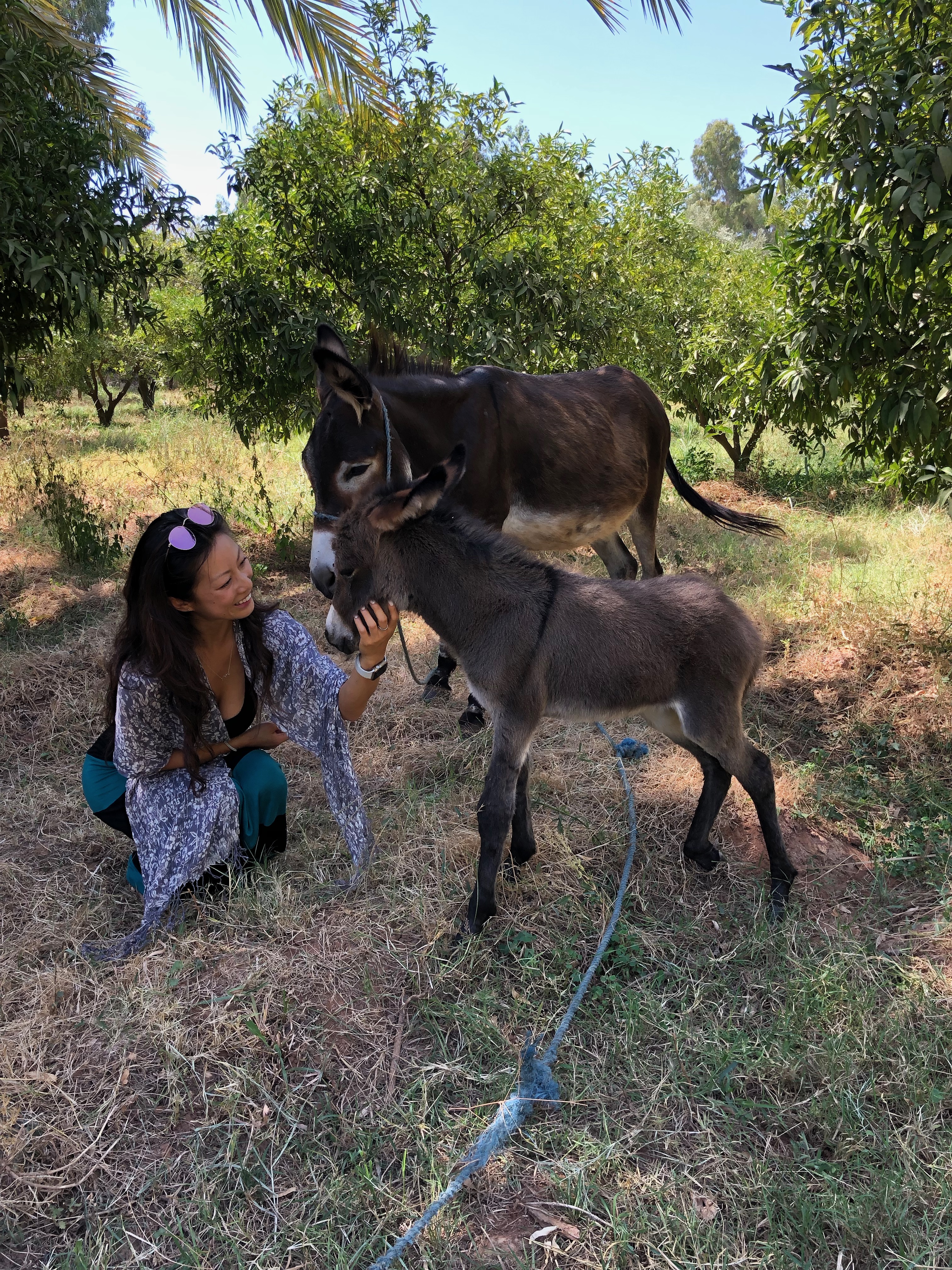
We visited this saffron garden off-season (in September) while the saffron flowers were dormant, so unfortunately, we were only able to see pictures of the harvesting process along the walls of the garden. The bloom and harvest season is in November. Fortunately, we had the entire garden to ourselves, and thus, a private tour of the grounds and surrounding orchards. We followed the keeper, Miloud, picking fruit like persimmons, kumquats, and pomegranates as we weaved between trees and scraggly bushes.
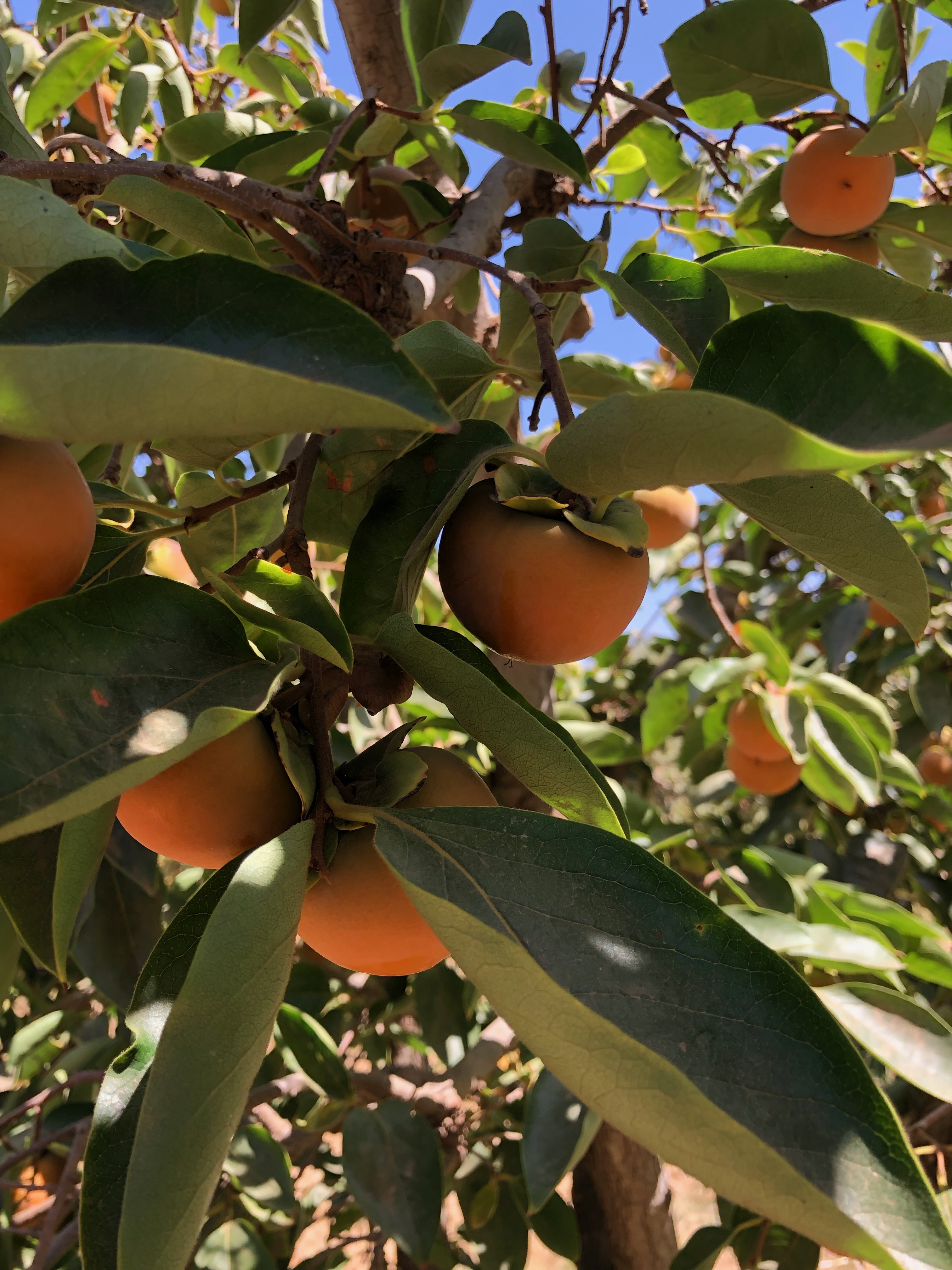


With the popularity and common uses of saffron, unsurprisingly, there are a lot of imitation saffron (in other words, fake saffron) sold in markets. Fake saffron can be made from dyed corn silk threads, coconut filaments, or even shredded paper! There are several ways to identify real saffron and avoid purchasing fake saffron. One of the most common ways is the water test, which is exactly what it sounds like–throwing a couple threads into water. Real saffron should turn the water yellow after a couple minutes of soaking, and the saffron threads itself should retain its red color.
It’s definitely worth the visit if you have time. Just keep in mind that with any “tour”, even if it’s unofficial, be prepared to pay a small “fee”. More on this below.

Marrakech
Ah, the red city. There are so many posts and common recommendations all over the interwebs for this city that I’ll spare you the repeat. Instead, I’ll highlight my favorite (and perhaps more unique) experiences here.

Walking along the narrow cobblestone alleys 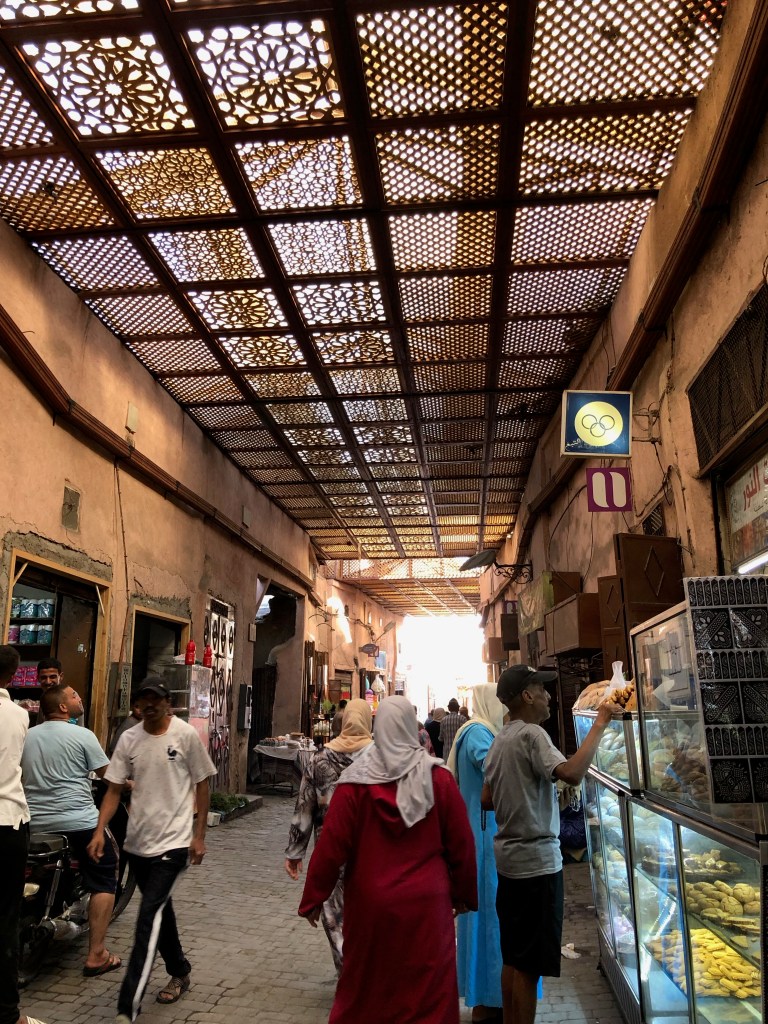
Weaving through the medina
When you visit Marrakech, you’ll no doubtedly walk through the Marrakech Medina, a walled city built around 1122. Inside, it is a labyrinth of souks, or traditional traders’ markets, crowded with locals and tourists alike. And as you would expect, the commotion from the many beggars, hagglers, and vendors, can be slightly overwhelming.
Café Snack Ben Mansour
This was our first meal in Morocco, and dare I say, the best. Arriving on a Sunday afternoon, we aimlessly walked around the walled city, mesmerized by the old buildings, narrow cobblestone alleys, and enraptured by a plethora of unfamiliar smells. Although I had been munching on snacks and fruit en route to Morocco, my stomach grumbled angrily, demanding a real meal. I looked at my watch. It was 4pm. Unsure of whether restaurants were open at this odd hour on a Sunday, I looked around and spotted Café Snack Ben Mansour. Empty tables and chairs dotted the restaurant front. An old man sitting in the back corner reading the newspaper glanced up at me and motioned for me to come over. He yelled something and suddenly a figure popped up from behind the counter, welcoming us in. We followed the owner into the restaurant and up a steep set of stairs that brought us to a lovely rooftop with a clear view of the Ben Salah Mosque and sweeping views of the medina.

Ignoring my ill-preparedness for the photo…this is the view of the Ben Salah Mosque from where we ate! 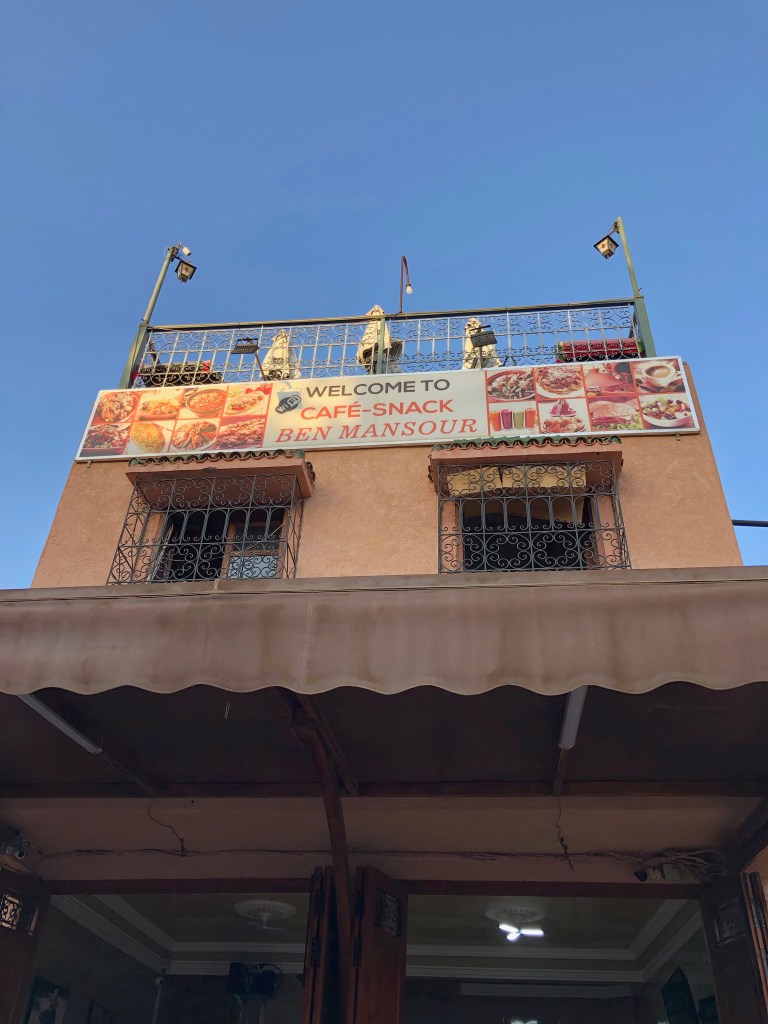
Cafe-Snack Ben Mansour
Despite the time of day, I was ready for a proper meal. Don’t let the name of the restaurant fool you. Café Snack Ben Mansour offers more than just “snacks”. I ordered a chicken tajine with vegetables, while my parents ordered a “meat” tajine—which we later found out was braised lamb. The perfect marriage of spices and tenderly braised meats were a dance party for my taste buds! And of course, to drink, we had none other than the traditional Moroccan mint tea. Morocco is known for their mint tea, and rightfully so! With the leaves brewed in the pot, the sweet and fragrant tea serves as a digestive aid.

Side note: On return home to the U.S., excited to try my new Moroccan tea set, I’ve tried to duplicate authentic Moroccan mint tea to no avail. Even following the recipe and steps to a T, I’ve concluded that Moroccan mint is naturally more intense in flavor versus the mint grown here in the United States.

Tannery Scam
Oh this is perhaps the oldest scam in the book! Stupidly, I didn’t educate myself on common scams prior to arrival. I’m slightly embarrassed to even be writing about this. Don’t make the same mistake I did. Read this. Be educated.
The tanneries, which are essentially open-air factories where leather is processed and dyed by hand, are supposedly a popular tourist attraction in Marrakech. There are signs for them at every corner, and locals jumping out at you shouting “Tannery? Tannery?” in the hopes of leading you there for a fee.
To make a long story short, we were fooled when a young gentleman told us that the tannery is only open once a week, and is completely free of charge. He fidgeted with his glasses as he introduced himself and noted the closing time of the tannery. The urgency in his voice was uncanny. We continued walking until he convinced us to follow him to the tannery, at which point, he handed us off to the “keeper” of the tannery. This gentleman introduced himself and handed us sprigs of mint, encouraging us to keep it close to our noses to avoid the pungent smell of curing hides that attack the nostrils immediately. He led us through the empty tannery, showing us the dried dye pits and rotten remains of scrap leather. Curious and wary eyes followed us as we walked through the tannery, careful not to step in questionable goo. The “tour” lasted no longer than 15 minutes, followed by a visit to a shop selling the leather goods that were supposedly handcrafted at the tannery. We looked around, but ultimately didn’t purchase anything. As we walked outside, the first gentleman that led us to the tannery was waiting for us, and behind him, the “keeper” that led us through the tannery. We thanked them, and my mom pulled out 20 MAD as a tip for their “kindness” and time. He held it in his palm, then shoved it back at my mom saying “No, no, no thank you. This is not enough.”
Excuse me, what?
He demanded 200 MAD (approx. $22) for the tour. I stood in shock for a moment thinking he was joking, until realization hit me…I had walked straight into a scam. In a flood of disgust and anger, I took a couple steps towards him and firmly said “No. We never agreed to this.” He continued to pressure us. Enraged, rolled up my sleeves, clenched my fists and yelled, “How dare you ask for 200 dirhams when you and your friend deceived us into this fake tour?” I don’t exactly remember what else I said, but I went off the rails. (Full disclosure: I was tired and it was getting dark. I didn’t want to deal with this. Looking back, this was definitely not a smart move. Had there been a mafia of these guys (which is usually the case), we could’ve been seriously injured…all for what, 20 bucks? If you find yourself scammed, just cough up the money, grab what’s left of your dignity, and walk away.) Yes, he and his friend eventually backed off when I held up my fists, preparing to throw a punch–again, not recommended, especially if you’re under 5 ft and 100 lbs. Point is, this happens way too often, and I wish I had done my due diligence before walking into the most common scam of all.
The most common things you’ll hear or be told that are COMPLETELY FALSE:
- “That road is closed”
- “You can’t go that way”
- “You’ll get lost if you go on your own”
- “If you want to see the tannery, you need to hire a guide.”
- “Today’s a special market day. Only once a week!”
- “I can show you the way, no charge”
Camel Ride in Afagay Desert
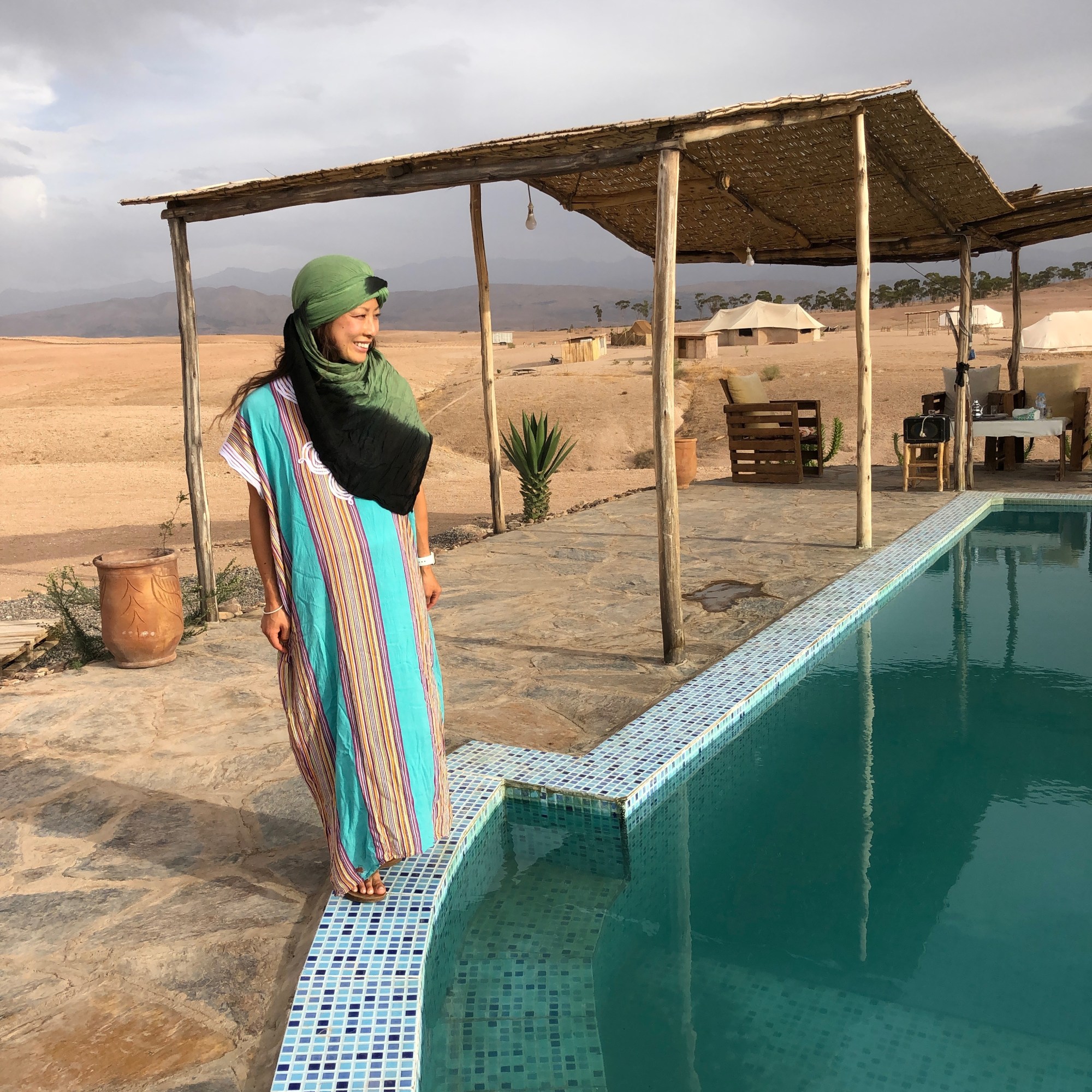
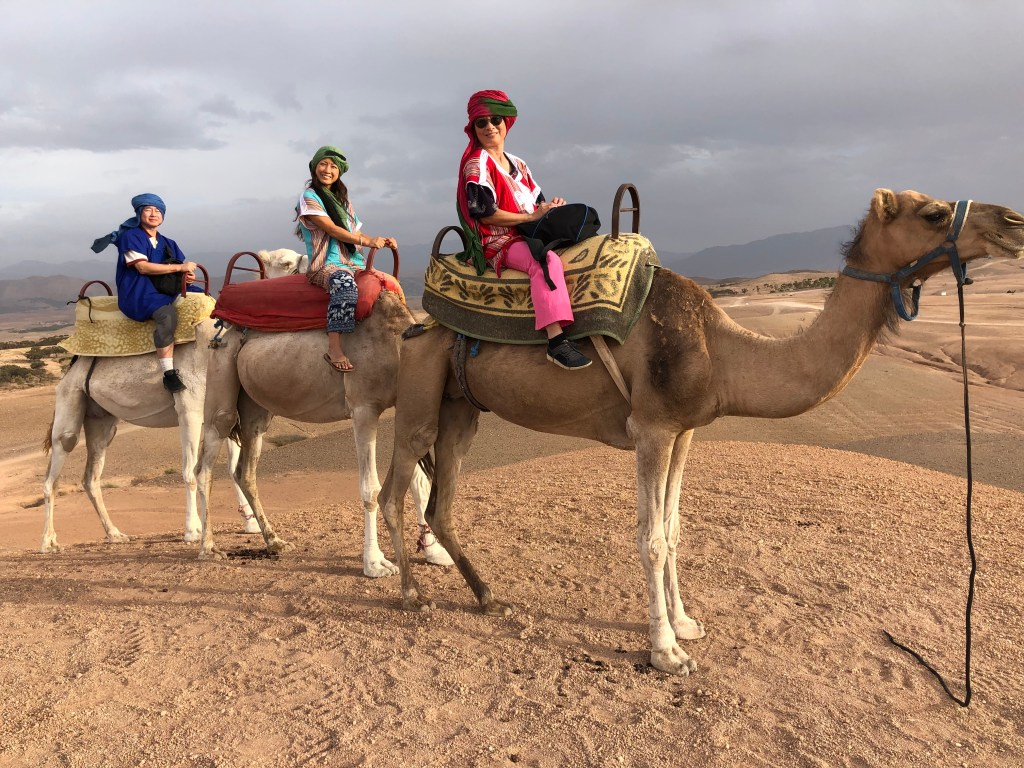
We booked this excursion through Airbnb experiences—first time ever trying this extension of Airbnb—and I’ve got to say, it didn’t disappoint! The transportation to the desert, the camel rides, enjoying dinner under the stars was seamless from start to finish. We were promptly picked up at our residence in a comfortable air-conditioned van, then shuttled to the Afgay Desert, about 45 minutes from the city center. Immediately upon arrival, we were handed off to our host who warmly greeted us with bottles of water. There were a mere two buildings—if you can even call it that, three Yurts, and a pool, amongst the barren desert. It was a strange sight, to say the least. We followed the host to the pool area and sat under the shaded pavilion where Moroccan tea and biscuits were immediately served. After spending half an hour sipping on tea and taking turns dipping out toes into the pool, our host brought out some traditional outfits for us to wear on our camel ride.
Don’t be a dick to the camels. They bite. Mom learned this the hard way. She didn’t heed to my warning, so I could only shrug at her misfortune.

Moulay Idriss/Vollubilis
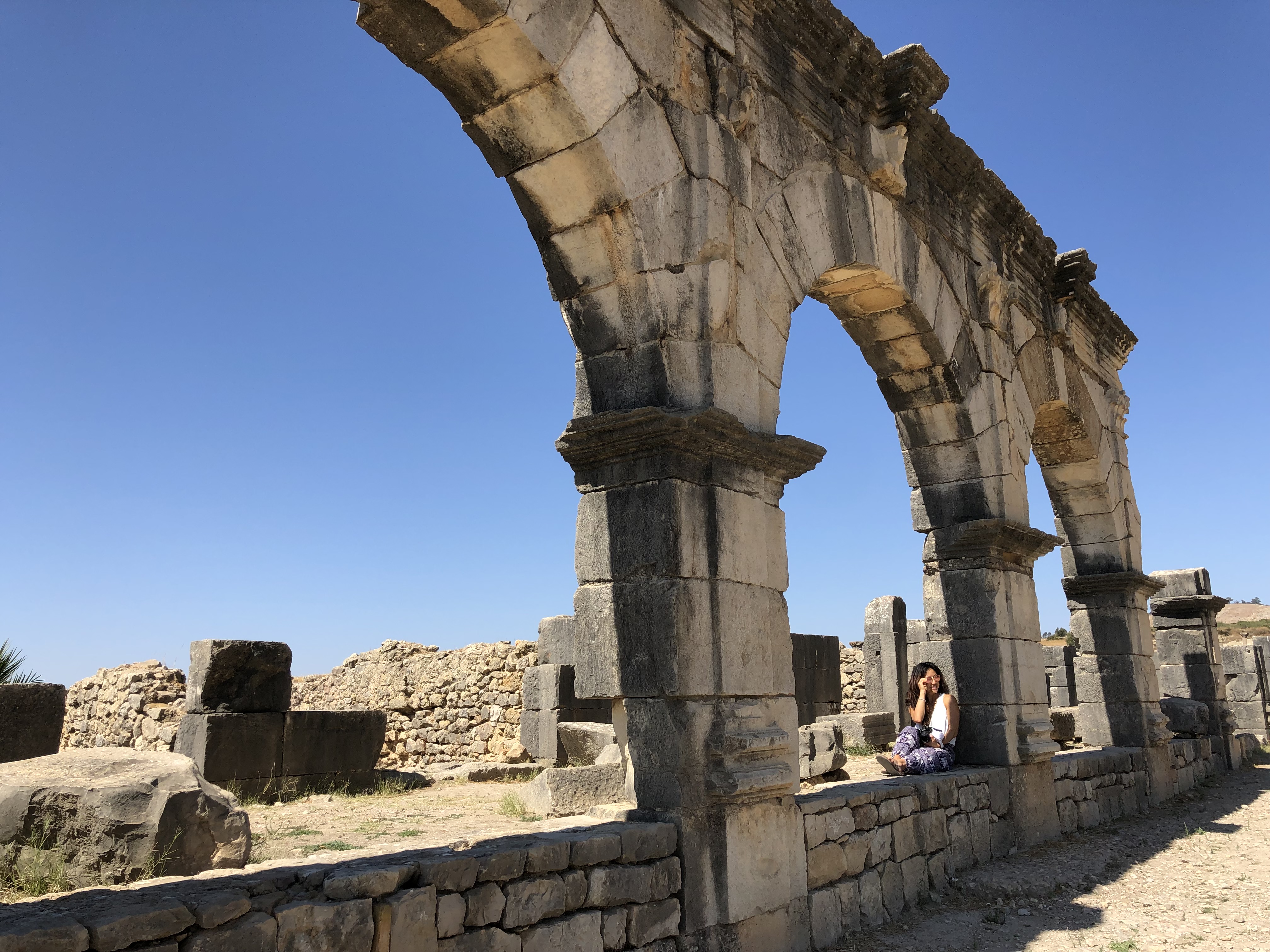
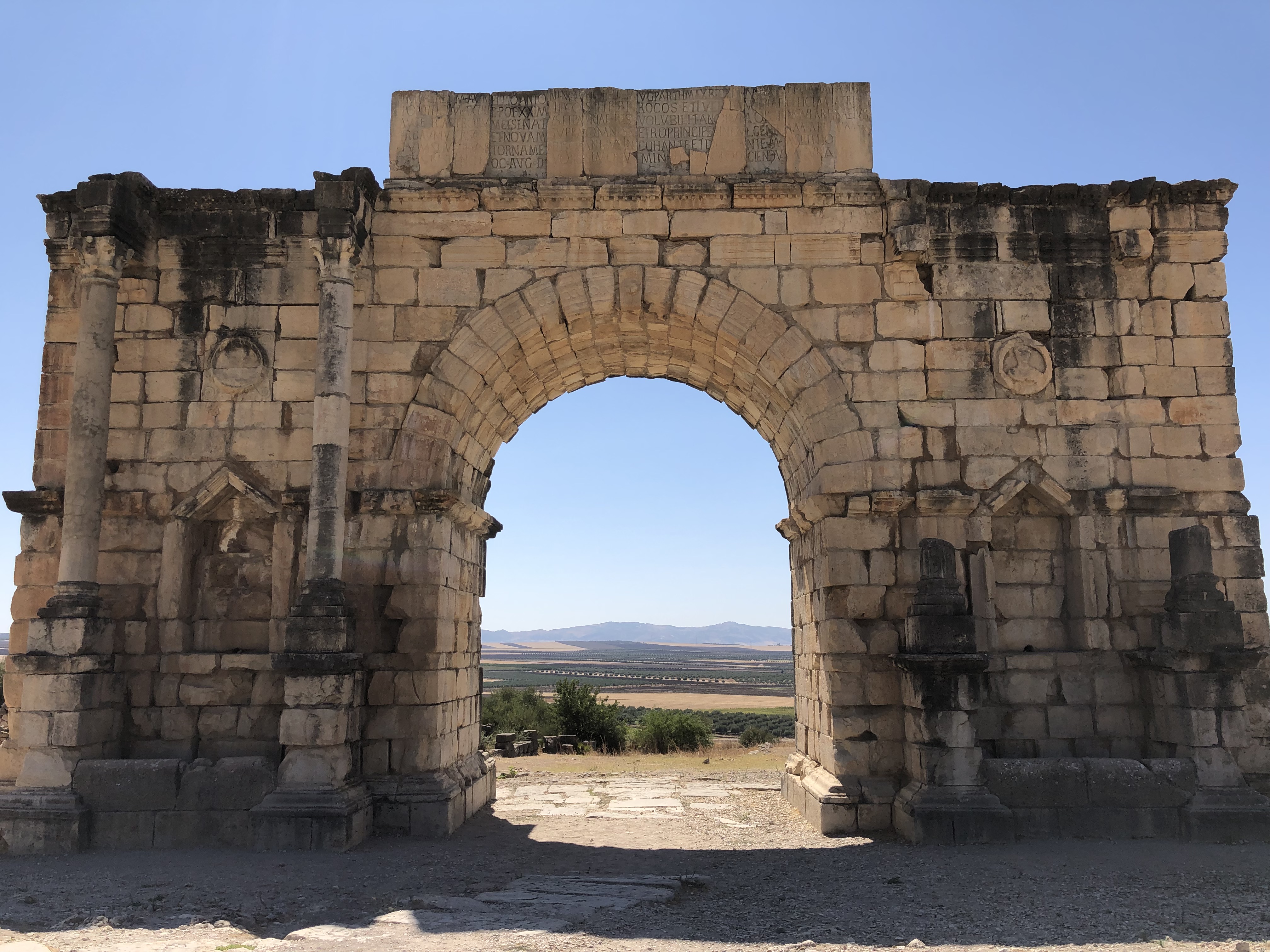
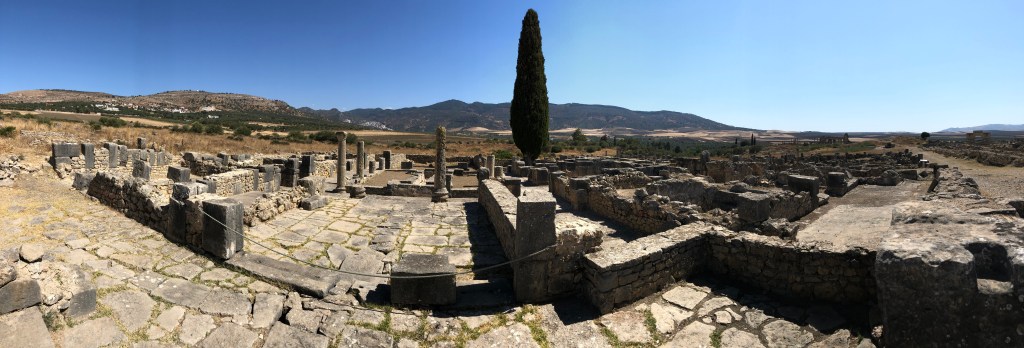
Almost all blogs and forums will tell you that Vollubilis is worth going out of your way for because the ruins are incredible. I can confidently concur with that sentiment!
On the way to Fes, we stopped in the town of Moulay Idriss. Just half an hour north of Moulay Idriss, lies the Roman ruins of Vollubilis.
Fes
Full disclosure: If it weren’t for my helpful hosts at Sebti Fes Riad, I probably wouldn’t have enjoyed this city as much. (I will emphasize again and again the advantages of knowing a local or hiring a guide.)

Where To Stay: Sebti Fes Riad
The hosts warmly welcomed us with tea and homemade pastries. From the outside, the riad doesn’t look like much, but contrary to its deceptive façade, it features four floors, vaulted ceilings, and a large backyard. The riad is adorned with traditional Moroccan décor—from handwoven textiles to antique chandeliers. The marble floors and intricately tiled walls immediately plunge you into feeling like you’ve arrived at the royal palace. And the hosts treat you like royalty, to that effect. A widely vacant pool and lounge chairs were beckoning me as I wiped the sweat from my face and massaged my aching back from the long drive. Needless to say, I spent most of my afternoon there.

Perspective from the Inside
I don’t want to make this into a patriotic rant on how privileged we are as Americans, but rather provide insight into Moroccan life, for you to make the judgement yourself. Keep in mind, that all this is anecdotal because these are the collective experiences of a handful of Moroccans I spoke to.
I spoke with a couple Moroccans between the ages of 20 and 50 to get a broad sense of life in Morocco. While most conversations were positive, I noticed that the young adults seem to voice their frustrations of socioeconomic inequality the most.
Life in Morocco can really vary depending on which city or region you live in. If you have a car, make $1000 a month, can afford a decent flat or apartment and private health insurance, life isn’t too bad. If you lack behind the elite class and fall into the (almost non-existent) middle class, life will be slightly harder with sub-standard public transportation and a barely maintained public healthcare system. Unfortunately, the majority falls into either the elite category or the impoverished. I don’t need to tell you how difficult it is to live on a measly $250 a month, if you’re even lucky enough to be the “upper” half of the impoverished. As you can imagine, there were a lot of homeless and beggars in every city we visited.

Education and Employment
One young individual I spoke to graduated from university last year with a degree in physics. He is still currently looking for a job and expressed his frustration in this process. “Morocco only achieves your demands with money. And if you want money, you have to work, and there is no work without money. This is the way of life here.”
When I asked about employment, another individual said, “It is so difficult. I have many diplomas, and it is not easy. Everyone here live with his parents”.
As I have read in other forums, expats have confirmed that Morocco is a good place to visit as a tourist, or to live in as an expatriate with a stable source of income, but the country is very challenging for the Moroccan youth.
Exploitation of Minors
When you travel on toll roads, you are bound to wait behind a line of cars entering the toll booths at some point. Almost every time, you’ll see individuals walk up and down alongside the line of cars soliciting for money or selling sweets. In one instance, I was taken aback when two children, no older than 9 or 10 years old, approached the car—one on the driver’s side and the other on the passenger side—to sell gum and other small snacks. At first, we paid no attention and avoided making eye contact, until both children violently banged their fists against the glass windows and even tried pulling the door handle. Shocked, I yelled “Hshuma!” (which means “shame on you”) in Moroccan Darija (Arabic). Completely unfazed, they continued to bang on the windows and pull on the door handles. I’m not sure if they thought this approach would convince people to buy their items, but it sure startled us. My first thought as I pulled away from the toll booth was, “shouldn’t they be in school?” The fact of the matter is, many children, especially impoverished children, don’t attend school. They either fall into this vicious cycle of poverty or assume the trades of their parents at a very young age. We also observed young children tending flock and working in the fields.
I’m sure this isn’t a surprise to many, especially since the exploitation of children is more rampant in less developed countries. However, I am always greatly saddened when I see these children on the streets incessantly begging for money or desperately trying to sell goods that, quite frankly, I don’t think anyone really wants. And most of the time, that money is snatched away by the abuser, leaving nothing for the child. Worst and most damning of all, there is a complete loss of childhood innocence. They are cruelly dropped into the dark realities of this world and often times, unable to crawl out of this whirlpool of abuse.
Genuine Hospitality or Bait-and-Switch?
I had a hard time trusting anyone who approached me after falling victim to the tannery scam on my first day in Morocco.

I want to hear your thoughts and experiences! Leave your comments below!
 Chu's Travel